
Running a Green Light

Obey the nature of things, and you are in concord with the Way, calm and easy and free from annoyance, but when your thoughts are tied, you turn away from the truth, they grow heavier and duller and not at all sound.

When they are not sound, the spirit is troubled, what is the use of being partial and one-sided then? If you want to walk the course of the One Vehicle, be not prejudiced against the six sense objects.

When you are not prejudiced against the six sense-objects, you are then one with the Enlightenment;

— Sosan Ganchi Zenji, 3rd Patriarch of Zen

When approaching an intersection with a traffic signal, how many of us would ever intentionally run a red light? None of us, right? What about running a yellow light or running green light? Is there such a thing?

Have you ever driven down a stretch of road with several intersections and all the lights were green? Did you ever speed up in order to reach the last light before it turns red? Did you ever think that you ignored the message of each green light- which is to proceed at your normal speed.

A green light does not mean speed up. Doing so is called running a green light!

And when we finally approach the last light and it turns yellow, we speed up even more, completely ignoring what the yellow light means- slow down and prepare to stop. To speed up instead is called running a yellow light!

What about ignoring our stress by nurturing our issues until something changes in our tissues and we feel physical pain? What about thinking of what we want to say next instead of really listening to someone?

Obey the nature of things, Sosan says, don’t ignore what your senses are telling you, and you are then one with the Enlightenment.

Can oneness with Enlightenment be this simple? Or maybe as simple as sitting quietly and following your breath?


Clinging is Out of Bounds

Clinging is never kept within bounds; it is sure to go the wrong way; quit it, and things follow their own courses, while the Essence neither departs nor abides.

Sosan Ganchi Zenji, 3rd Patriarch of Zen

As I leave the house one hypothetical morning, I am pleased with how centered I am and flowing with the Dharma. Then someone cuts me off in traffic, the person ahead of me in the express line at the grocery store checks out with way more than 15 items, my head is boiling in response to an ignorant Facebook post, and when I finally get to my meditation cushion that evening, I replay all of it as if I needed to suffer even more!

What is happening here? Zazen tells us that if we attach ourselves externally, we have stepped out of bounds of the Dharma Path. In most games, when we step out of bounds, play stops. Time out!

How then can we stay on the Dharma Path when confronted with frustrating grocery lines, chaotic traffic, and narrow views? I remember as a boy, running through boulder fields, hopping from rock to rock as fast as I could. I remember how focused I needed to be to keep from falling. To move slowly seemed even more difficult.

What if we received actions of frustrating people and situations as if they were boulders on our path? What if we chose to bounce through this boulder field joyfully instead of dwelling on how uneven the path is?

Where then would the Essence of the Dharma Path be found?

Calm and Large-Hearted

The Great Way is calm and large-hearted; for it nothing is easy, nothing is hard; small views are irresolute. The more in haste the tardier we go.

— Sosan Ganchi Zenji, On Believing in Mind

Election speeches are filled with both big and small ideas-big ideas about the higher good and small ideas imbued with fear and xenophobia.

If returning to the Great Way in the midst of political turmoil via one Emptiness seems abstract or too Zen, then Sosan helps with a generous expansion of his message.

The Great Way is calm and large hearted he says. Where can we find this in the midst of political discourse or daily life? We simply need to listen for it.

This is why sitting is so important. Zazen helps us listen to the rhetoric and feel the underlying truth.

This is because in Zen there are no big ideas, no small ideas, no hard work, no easy work, no quick solutions, no slow solutions.

All we need to know is that small views are irresolute. In other words small ideas never get resolved! So, in our day to day life, if we are struggling, it is safe to assume that small, dualistic views have grasped us.

In a certain sense, we don’t need to know anything more about the Way. Sosan has expressed its essence already here and in previous passages presented in these emails:

  • The Great Way is perfect like unto vast space
  • The Great Way rests in one Emptiness.
  • The Great Way is calm and large hearted.

What more do we need to know?

Can we feel the Large Heart of the Great Way arise within us during Zazen?

Can we perceive its reflection in everything we feel, taste, smell, hear, see, and think?

One Emptiness

Abide not with dualism, carefully avoid pursuing it; as soon as you have right and wrong, confusion ensues and Mind is lost.

The two exist because of the One, but hold not even to this One; when a mind is not disturbed, the ten thousand things offer no offense.

No offense offered, and no ten thousand things; no disturbance going, and no mind set up to work; the subject is quiet when the object ceases, the object ceases when the subject is quieted.

The object is an object for the subject, the subject is a subject for the object; know that the relativity of the two rests ultimately in one Emptiness.

Sosan Ganchi Zenji, On Believing In Mind

When a conflict arises with our spouse, partner, coworker, or child, when we hear about terrorism or acts of brutality and injustice, how do we respond according to the Way? Sosan tells us that right and wrong, good and bad, truth and falsehood, love and hate rest in one Emptiness.

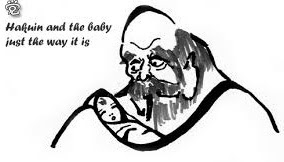
Last week we heard Hakuin reply in the face of judgment and falsehood, ” Is it so? “. His response emerged from emptiness, an emptiness from which a compassionate response arose without effort or thought, without moral obligation or a sense of pity.

Hakuin was empty, but not passive or inert. He expressed no preference or judgment when presented with the baby, yet all was resolved of its own accord.

Just as the couple abandoned the baby, then confessed the truth and retrieved the baby, Hakuin returns to his response again and again, ” Is it so? “.

So too in Zazen does our breath, like Hakuin’s response, arise again and again of its own accord, compassionately sustaining us without effort or thought.

Is that so?

Wordiness and intellection- the more with them the further astray we go; away therefore with wordiness and intellection, and there is no place where we cannot pass freely.

When we return to the root, we gain the meaning; when we pursue external objects, we lose the reason. The moment we are enlightened within, we go beyond the voidness of a world confronting us.

Transformations going on in an empty world which confronts us appear real all because of ignorance; try not to seek after the true, only cease to cherish opinions.

— From On Believing in Mind, Sosan Ganchi Zenji, 3rd Zen Patriarch

This passage reminds me of a story about one of the great Zen Masters, Hakuin Ekaku, b.1686-d.1769.
Master Hakuin And The Baby
The great Zen Master Hakuin lived in a small hut outside a village where he was greatly respected. One day a village girl announced she had become pregnant. The father of the baby left town and she was alone and frightened. She did not know what else to do and told the entire village that Master Hakuin was the father.

All the townspeople were shocked. They stopped bringing Hakuin food and offerings. Instead of praising Hakuin. they now blamed him. “You are the worst of all beings,” they said.
“Is that so?” replied Hakuin.
When the baby was born the village girl brought the child to Hakuin.
“This baby is yours,” she said.
“Is that so?” Hakuin said and took the baby.
Hakuin cared for the baby for several years, feeding, clothing and caring for the child. Then, one day, the father of the baby returned to the village to marry the mother. The new couple told everybody the truth about what happened. The people were astonished and began to praise Master Hakuin, rushing to his hut with offerings. When they announced that the father had returned and that the couple had revealed the truth, Hakuin replied: “Is that so?”

Soon the couple and the girls parents arrived at Hakuins hut and announced that they were going to take the baby back. Hakuin simply responded: Is that so and handed them the child.

What is the connection between Hakuin’s response, “Is that so?” and Sosan’s passage? Consider this “…when you return to the root…”.Can you see how Hakuin returns to the root? Can you see directly into this matter in your zazen?

Don’t Hurt Your Head!

Pursue not the outer entanglements, dwell not in the inner void,
be serene in the oneness of things,
and dualism vanishes by itself.

When you strive to gain quiescence by stopping motion,
The quiescence thus gained is ever in motion,
As long as you tarry in dualism,
How can you realize oneness?

And when oneness is not thoroughly understood,
In two ways loss is sustained:
The denying of reality is the asserting of it; and,
The asserting of emptiness is the denying of it.

— From On Believing in Mind, by Sosan Ganchi Zenji, 3rd Zen Patriarch

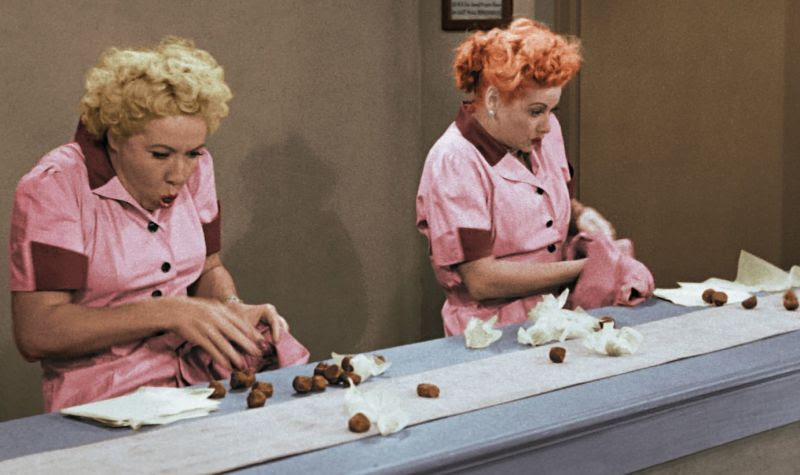
Thinking hard about this ​hurts my head! The phrase, When you strive to gain quiescence by stopping motion, The quiescence thus gained is ever in motion, reminds me of this famous scene from the I Love Lucy TV show:

https://www.youtube.com/watch?v=8NPzLBSBzPI

The funny part is that Lucy and Ethel’s attempts to stop motion have the opposite effect. Their supervisor speeds up the conveyor!

Can you imagine the result if Buster Keaton’s character attempts to stop the motion in this scene?

In Buster Keaton’s scene, his character’s ignorance saves him. He neither denies nor asserts the reality of the falling wall. And he neither asserts nor denies emptiness of mind because he simpl​y​ does not know that the wall is falling toward him until it hits the ground.

So without resorting to ignorance or simply “sticking our head in the sand”, how can we find the middle ground between the inner void and the outer entanglements? Let’s not think about it. That hurts my head! How ’bout we just sit and breathe into it?

Finding a Lost Object

The Way is perfect like unto vast space,With nothing wanting, nothing superfluous.
It is indeed due to making choices that its suchness is lost sight of.

— Sosan Ganchi Zenji

This passage is the 3rd in On Believing in Mind by Sosan Ganchi Zenji. This passage reminds me of looking for a lost object to the point of frustration; and then, upon giving up the search, the lost object magically appears.

Sosan’s passage resonates with this experience in an interesting way. Note that Sosan does not say the Way is perfect like vast space. Instead, he says the Way is perfect like unto vast space implying an action, a process, or movement with respect to vast space.

So what does this have to do with looking for a lost object only for it to be revealed upon abandoning the search? And more so, what does this have to do with Zazen meditation?

Life can be frustrating and unsettling if we seek the Truth outside ourselves. Zazen invites us to abandon everything with our breath- our thoughts, our feelings, our physical pain, even our own life!

And as we enter this path with total trust, can we begin to sense what magically reveals itself?

The egg yolk is the soul and the egg white is the spirit

In one Emptiness the two are not distinguished.
And each contains in itself all the ten thousand things; when no discrimination is made between this and that, how can a one-sided and prejudiced view arise?

Sosan Ganchi Zenji, On Believing in Mind

The other day I was talking to a friend about the tension between purifying our hearts and embracing the sloppiness of the soul. Since I have been eating lots of hard boiled eggs lately, this image of the yolk as the soul and spirit as the egg white came to mind as a way of imagining how spirit and soul work together in self -transformation. And it was at HEB when I was buying eggs that a woman reached for the carton of egg beaters with the yolks removed.

I thought , ” Hhmmm, eggs with no soul, interesting. “

My zen teacher and Abbot of Dai Bosatsu Zendo, Shinge Roshi, frequently talked about the importance of returning to this one Emptiness in our zazen practice and in life. The focus was not on attaining kensho, or enlightenment, but simply returning to our breath during zazen, returning to the cushion daily to sit, returning to our true nature when we find ourselves caught up in circumstance, reactivity, ego or feelings of despair.

Abstractions about soul, spirit, purification, and ecstatic spiritualism, are integral to religious teaching and in helping us to get over ourselves. But in zazen this is no place to linger. When we think we know the answer, and we are aware of the potential pitfalls here {as in the eggs without soul}, returning to one Emptiness can be a safe refuge.

Always returning, always returning.
Her deeply sincere words
Directed to the heart of her being:
“ I am sorry” , “ It’s Okay It’s Okay”
Returning, returning
We forget and we return
We screw up and we return
Return to one Emptiness.

To what purpose is our mind disturbed?

To set up what you like against what you do not like- this is the disease of the mind; when the deep meaning of the Way is not understood, peace of mind is disturbed to no purpose.

— Sosan Ganchi Zenji

I read a Facebook post this week in which a young man related how grateful he was for his drug addiction. He explained that if it were not for his drug addiction, he would never have found his current path of healing and health.

Even though he had been sober for years, he faced addiction every day. By embracing his addiction daily and making the choice to live free of it, he had grown to understand the deep meaning of the Way.

For him, peace of mind was not about getting rid of his desire to get high. In fact, the mental disturbance of addiction was intrinsic to his peace of mind.

A lot of times we seek out meditation to feel better, to escape bad things in life in order have more good things, kind of like a drug fix for an addict. But Zazen compels us to face both the good and the bad as two aspects of one thing. Well, what is this One thing?

Consider these questions:

  • To what purpose is my mind disturbed?
  • How is this disturbance leading me to true peace of mind?

These are great questions to ask ourselves in our daily meditation. Can you sense how asking these questions draws us closer toward this One thing? This One thing which holds the deep meaning of the Way?

Three Questions

Someone confided in me today that they were nervous about coming to meditation because they did not feel advanced enough in their meditation practice. Do you feel the same way? Consider the following questions:

  1. Can you sit still for 15 minutes with your back straight?
  2. Can you keep your gaze toward the floor?
  3. Can you count each breath up to 10 breaths?

If we answer yes to these questions, then we are able to meditate. All we need to do then is bring our anxiousness with us, observe it in our meditation, and return to our breath.

As we move through life this week and feel anxious, nervous, or ill at ease in any way, we are offered perspective in “Shin Jin Mei” (On Believing in Mind) :

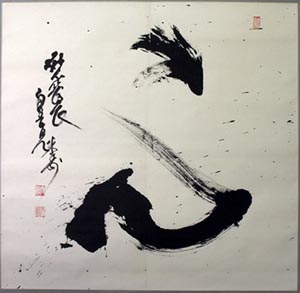
Calligraphy by Eido Tai Shimano Roshi, Kokoro/Shin (Heart Mind)- “The Core of Our Being”

The Perfect Way knows no difficulties,
except that it refuses to make preferences;
only when freed from hate and love, It reveals itself fully
and without disguise;

a tenth of an inch’s difference,
and heaven and earth are set apart;

if you wish to see it before your own eyes,
have no fixed thoughts either for or against it.

….One in All, All in One-
If only this is realized, no more worry about your not being perfect!

May we move through our week with ease in perfect imperfection!